The short answer is no, you cannot vape in most hotel rooms in the United States in 2026. Approximately 92% of major hotel chains now enforce strict no-vaping policies, backed by sophisticated detection technology that identifies vapor chemical signatures. Hotels impose cleaning fees ranging from $150 to $500 when guests violate these policies, as vapor residue adheres to surfaces and fabrics, requiring specialized remediation to protect subsequent guests and maintain room quality.
Understanding Hotel Vaping Policies in 2026
The hospitality industry has undergone a dramatic transformation regarding vaping policies in hotel rooms. As of 2026, chains including Marriott, Hilton, Hyatt, IHG (Holiday Inn), and Choice Hotels maintain comprehensive smoke-free and vape-free policies across their U.S. properties. This shift reflects growing scientific understanding of thirdhand vapor residue and guest sensitivity to chemical exposure. Unlike the early 2010s when vaping existed in a regulatory gray area, hotels now treat e-cigarette vapor identically to traditional cigarette smoke in their enforcement protocols.
Major hotel brands updated their policies between 2018 and 2023 after observing increased guest complaints about vapor odors and residue transfer. Research from Cornell’s School of Hotel Administration found that rooms where vaping occurred required 40% more deep cleaning time and showed measurable chemical deposits on soft furnishings even after standard housekeeping. This evidence drove policy standardization, with cleaning fees now averaging $275 across mid-tier properties and reaching $500 at luxury establishments. These fees reflect actual remediation costs rather than punitive charges, as hotels document expenses for specialized cleaning solutions, extended labor, and room downtime.
How Hotels Detect Vaping in Rooms
Modern hotels deploy multiple detection methods for vaping that extend far beyond traditional smoke alarms. The most sophisticated properties use environmental sensor networks that continuously monitor air quality, identifying specific volatile organic compounds (VOCs) associated with e-cigarette aerosols and cannabis vapor. Companies like FreshAir Sensor and Wynd Technologies provide hospitality-grade detectors that differentiate between vaping signatures and legitimate sources like hair products or cleaning supplies, achieving accuracy rates exceeding 96% according to 2025 industry testing.
These smart hotel sensors analyze air composition in real-time, detecting glycerin particles, propylene glycol, nicotine derivatives, and terpenes from cannabis products. When vaping occurs, the system alerts hotel management through integrated property management software, providing timestamp data and chemical composition analysis. Beyond electronic detection, hotels employ trained housekeeping staff who recognize tell-tale signs: sweet residue on mirrors and windows, glycerin film on television screens, and characteristic odors in fabrics that differ from cigarette smoke. Some properties conduct black-light inspections during checkout, revealing vapor residue patterns invisible to the naked eye. The combination of technology and human observation creates a detection framework that makes undetected vaping increasingly difficult.
Types of Vape Detection Technology
Hotels implement various vape detector systems based on property tier and budget. Entry-level solutions include modified smoke alarms with enhanced particulate sensors that respond to dense vapor clouds, though these generate occasional false positives from steam or aerosol sprays. Mid-range properties typically install dedicated air quality monitors like the Wynd Sentry, which costs approximately $200 per unit and detects PM2.5 particles characteristic of vaping. These devices mount discreetly on walls or ceilings, resembling standard carbon monoxide detectors, and connect via WiFi to centralized monitoring systems.
Advanced Chemical Signature Detection
Premium hotels invest in sophisticated sensors that perform chemical composition analysis of room air. The FreshAir Sensor 2.0, deployed across luxury chains since 2024, uses spectrometry technology to identify specific molecules in vaping aerosols, including flavoring compounds, nicotine, and THC. These systems cost $400-$600 per room but provide court-admissible detection evidence that withstands guest disputes. The technology distinguishes between vaping and legitimate activities with 98% accuracy, reducing false accusations while ensuring policy enforcement. Data shows that properties with advanced detection see 73% fewer vaping incidents compared to those relying solely on traditional smoke alarms.
Integrated Smart Room Systems
The newest generation of hotel room monitoring integrates vape detection with comprehensive environmental controls. Systems like Marriott’s IoT Room platform and Hilton’s Connected Room technology include air quality sensors as standard components, monitoring temperature, humidity, VOCs, and particulate matter simultaneously. These platforms provide predictive analytics that identify vaping patterns by time and guest demographics, helping hotels optimize policy communication. When integrated sensors detect vaping, they automatically adjust HVAC systems to increase air exchange rates, minimizing residue spread to adjacent rooms. This proactive approach reduces remediation costs by 35% compared to reactive cleaning after checkout discovery.
What Happens If You Vape in a Hotel Room
Guests caught vaping in non-smoking hotel rooms face immediate and escalating consequences. Initial detection typically results in a courtesy warning via phone call or room visit from security staff, documenting the violation in the property management system. If vaping continues, hotels exercise their right to immediate reservation termination without refund under breach-of-contract provisions present in virtually all booking agreements. The guest receives notice to vacate within 30-60 minutes, and security may escort them from the property if they refuse to leave promptly.
Financial consequences prove substantial: hotels charge cleaning fees between $150-$500 to the credit card on file, and these charges rarely succeed in disputes since detection technology provides objective evidence. Major chains like Hilton and Marriott place violation notes on guest profiles, potentially affecting future booking approvals and loyalty program status. Repeat offenders find themselves on internal do-not-rent lists shared across franchise properties. In egregious cases involving cannabis vaping in states where hotel use remains prohibited, properties may file police reports, though this occurs in fewer than 2% of incidents. The 2026 industry standard emphasizes financial remediation over criminal prosecution, recognizing that most violations stem from ignorance rather than malice.
Cleaning Fees and Financial Penalties
Hotel vaping cleaning fees reflect documented remediation costs rather than arbitrary penalties. Standard protocols require deep cleaning that extends beyond routine housekeeping: specialized enzymatic cleaners for fabric surfaces, glass and mirror treatment to remove glycerin film, HVAC filter replacement, and extended ozone or hydroxyl generation treatment for severe cases. Budget properties typically charge $150-$200, covering 2-3 hours of enhanced cleaning labor plus materials. Mid-scale hotels assess fees of $200-$350, while luxury properties charge $400-$500, reflecting higher labor costs and brand standards requiring complete odor elimination.
These charges appear on guest folios as policy violation fees or deep cleaning charges, clearly itemized with date and time stamps matching detection events. Hotels photograph affected rooms before remediation, documenting visible residue or sensor readings as evidence for disputed charges. Credit card processors side with hotels in 89% of chargeback attempts when properties provide detection data and photographic evidence. Some chains implement tiered penalty structures: first offense incurs the base cleaning fee, while subsequent violations within 12 months trigger fees 150-200% higher. Additionally, hotels may claim lost revenue if rooms remain out of service beyond standard turnover time, though this occurs primarily in high-occupancy periods when deep cleaning forces room unavailability extending 24-48 hours.
Will Vaping Set Off Hotel Smoke Alarms
Traditional ionization smoke alarms rarely trigger from normal vaping activity, as e-cigarette vapor contains larger particles than smoke and dissipates quickly without sustained combustion products. However, dense vapor clouds produced by sub-ohm devices or repeated use in enclosed spaces can activate older smoke detectors, particularly photoelectric models sensitive to any airborne particles. Industry data from 2025 indicates that approximately 12% of hotel smoke alarm activations in non-smoking rooms result from vaping with high-output devices, typically during the first 30 minutes after check-in when guests mistakenly believe vapor won’t trigger alarms.
Modern hotels install multi-sensor fire detection systems that analyze smoke composition, temperature changes, and carbon monoxide levels simultaneously before triggering building-wide alarms. These advanced systems recognize vaping signatures and generate silent alerts to security staff rather than activating evacuation protocols, preventing false emergencies while still documenting violations. When a smoke alarm does activate from vaping, consequences intensify beyond standard cleaning fees: hotels may assess additional charges for emergency response costs, typically $100-$300, covering fire department coordination and guest inconvenience from false evacuation. Some jurisdictions impose municipal fines for false alarms, ranging from $250-$500, which hotels pass directly to responsible guests. Properties in high-rise buildings face particular scrutiny, as unnecessary evacuations create safety risks and operational disruptions affecting hundreds of guests simultaneously.
Differences Between Vape Pens and Larger Devices
Detection likelihood varies significantly based on vaping device type and usage patterns. Small vape pens and pod systems like JUUL or Vuse produce minimal vapor clouds that dissipate within seconds, making them harder to detect through particulate sensors unless used repeatedly in quick succession. These devices generate approximately 0.5-2 milliliters of vapor per puff, with particle concentrations of 10-30 micrograms per cubic meter, often below threshold levels for basic air quality monitors. Users asking can I hit my pen in a hotel room should understand that while detection probability is lower, it’s far from zero, particularly in properties with advanced chemical sensors.
Conversely, sub-ohm devices and box mods produce vapor volumes 5-10 times greater than pen-style devices, generating visible clouds that linger for minutes and deposit substantial glycerin residue on surfaces. These high-output systems trigger detection almost immediately through both particulate and chemical sensors. Cannabis vape pens present additional detection risks, as terpene compounds create distinctive aromatic signatures that persist in room air and fabrics for hours after use. Even low-temperature cannabis vaporizers produce volatile organic compounds detectable by advanced hotel sensors at concentrations as low as 5 parts per billion. Housekeeping staff receive training to identify the characteristic sweet, herbal odor of cannabis vapor, which differs markedly from nicotine-based products and conventional smoke.
Strategies Some Guests Try and Why They Fail
Guests attempting to vape undetected in hotel rooms employ various strategies that prove largely ineffective against modern detection systems. Common approaches include vaping in bathrooms with exhaust fans running, using towels under doors, exhaling into damp cloths, or positioning near open windows. While these methods reduce immediate vapor concentration in main room areas, they fail against chemical sensors that detect residual compounds in air circulation. Bathroom fans exhaust to shared HVAC systems in many hotels, spreading vapor signatures to monitoring points rather than eliminating them.
The misconception that vaping near windows prevents detection ignores the reality that glycerin and propylene glycol particles adhere to glass surfaces, curtains, and window frames, remaining visible during inspection as filmy residue. Some guests attempt to mask vapor by running hot showers to generate steam, but modern sensors differentiate between water vapor (pure H2O) and vaping aerosols containing complex organic compounds. Using air fresheners or odor eliminators actually increases detection likelihood, as these products add additional VOC signatures that trigger investigation. Techniques discussed on platforms like Reddit, such as vaping into air conditioning vents, merely distribute evidence throughout the HVAC system, where it contacts sensors designed specifically to monitor air quality at intake and exhaust points. The fundamental failure of all evasion strategies is that they address only immediate visible vapor while ignoring chemical residue that persists for hours and provides irrefutable detection evidence.
Legitimate Alternatives for Hotel Guests Who Vape
Hotels accommodate vaping guests through designated outdoor areas and modified policies that balance personal freedom with property protection. Virtually all U.S. properties maintain outdoor spaces where vaping is permitted, typically the same locations designated for traditional smoking: patios, designated courtyard sections, or areas at least 25 feet from building entrances per local ordinances. These spaces include weatherproof ashtrays and waste receptacles, and hotels increasingly provide seating and shelter to enhance guest comfort while protecting indoor air quality.
Guests requiring frequent vaping access should specifically request smoking-permitted rooms during booking, available at approximately 35% of full-service hotels in 2026. These rooms, typically limited to 5-15% of total inventory, undergo enhanced ventilation and cleaning protocols, commanding premium rates of $25-$75 per night. Properties like certain Casino hotels in Nevada and select extended-stay chains maintain larger smoking-permitted inventories. Third-party booking platforms now include smoking/vaping room filters, simplifying property identification for guests who require this accommodation. Another option involves boutique hotels and independent properties with flexible policies, particularly in states with recreational cannabis legalization. Some properties offer private patios or balconies attached to ground-floor rooms, providing personal outdoor space where vaping is permitted. Extended-stay properties with kitchenettes sometimes feature balconies or outdoor terraces, giving guests legitimate private areas for vaping without policy violations.
Health Considerations: Special Cases
Guests with health conditions related to vaping face unique considerations when traveling. Individuals with respiratory conditions including emphysema, chronic obstructive pulmonary disease (COPD), or asthma should understand that even secondhand exposure to vapor residue in hotel rooms poses health risks. Studies from the American Lung Association confirm that glycerin and propylene glycol particles irritate compromised respiratory systems, potentially triggering exacerbations. Hotels increasingly market rooms as allergen-reduced or hypoallergenic, guaranteeing absence of smoke and vapor residue for guests with chemical sensitivities.
The question of can you vape with emphysema extends beyond hotel policies to fundamental health concerns. Medical evidence from 2024-2025 research published in the Journal of Respiratory Medicine demonstrates that vaping causes measurable lung function decline in emphysema patients, with vapor particles penetrating damaged alveoli more readily than in healthy individuals. The heating elements in vaping devices produce ultrafine particles smaller than 2.5 microns that bypass natural respiratory defenses, depositing directly in diseased lung tissue. Pulmonologists universally recommend against vaping for patients with emphysema, noting that while e-cigarettes eliminate combustion products from traditional smoking, they introduce different harmful compounds including heavy metals from heating coils and chemical flavoring agents linked to lipoid pneumonia. Patients using nicotine replacement therapy should opt for FDA-approved alternatives like patches, gum, or lozenges that avoid inhalation risks entirely while traveling.
State and Local Regulations Affecting Hotel Vaping
Legal frameworks governing vaping in hotels vary significantly across U.S. jurisdictions, creating complex compliance landscapes for national chains. Twenty-three states have enacted comprehensive indoor vaping prohibitions that explicitly include hotel rooms, treating e-cigarettes identically to traditional tobacco products under clean indoor air acts. States including California, New York, Massachusetts, and New Jersey impose strict regulations requiring hotels to maintain 100% smoke-free and vape-free room inventories, with limited exceptions for dedicated smoking floors in properties exceeding 250 rooms, built before specific dates, and meeting enhanced ventilation standards.
Local ordinances often exceed state requirements: cities like San Francisco, Boston, and Chicago prohibit vaping in all indoor public accommodations without exception, defining hotel rooms as public spaces during occupancy periods. Violations trigger fines against properties ranging from $500-$2,500 per incident, incentivizing aggressive detection and enforcement. Conversely, states with minimal vaping regulation like Wyoming, Mississippi, and Kentucky allow hotels to establish their own policies, though major chains maintain consistent nationwide standards regardless of local permissiveness. Cannabis vaping faces additional restrictions even in recreational legalization states, as federal law prohibits cannabis use on commercial property that accepts federal funding or serves interstate commerce. This creates situations where cannabis vaping remains prohibited in hotels even in states where adult use is fully legal, a distinction many travelers overlook. Hotels in legalization states clearly communicate these restrictions during check-in, and some properties in Colorado and California have faced civil liability when guests injured others while impaired after consuming cannabis products in rooms, motivating strict enforcement.
How Reddit Communities Discuss Hotel Vaping
Online discussions provide insight into guest experiences and strategies regarding vaping in hotel rooms. Subreddits like r/electronic_cigarette and r/vaping contain hundreds of threads where users share experiences, with the consensus that attempting to vape undetected poses significant financial risk relative to minimal inconvenience of using designated outdoor areas. A 2025 analysis of Reddit discussions found that approximately 67% of users reporting vaping in hotel rooms ultimately faced consequences, contradicting the perception that evasion is easy or common.
Specific questions like how do hotels know if you vape in the room reddit generate detailed responses from hospitality workers explaining detection methods, providing insider perspectives that contradict guest assumptions. Former housekeepers describe training to identify glycerin residue, while front desk staff explain how modern property management systems flag rooms with detection alerts, triggering enhanced inspection protocols. Discussions about specific chains reveal that Hilton properties receive particular attention, with users asking about Hilton vape detector Reddit experiences and sharing that the brand’s portfolio-wide sensor deployment began in 2023, making it among the most detection-capable chains. Users consistently advise booking smoking-permitted rooms or using outdoor areas, noting that cleaning fees and potential reservation termination far outweigh the minor inconvenience of taking a brief walk outside for vaping.
What Vape Detectors Actually Look Like
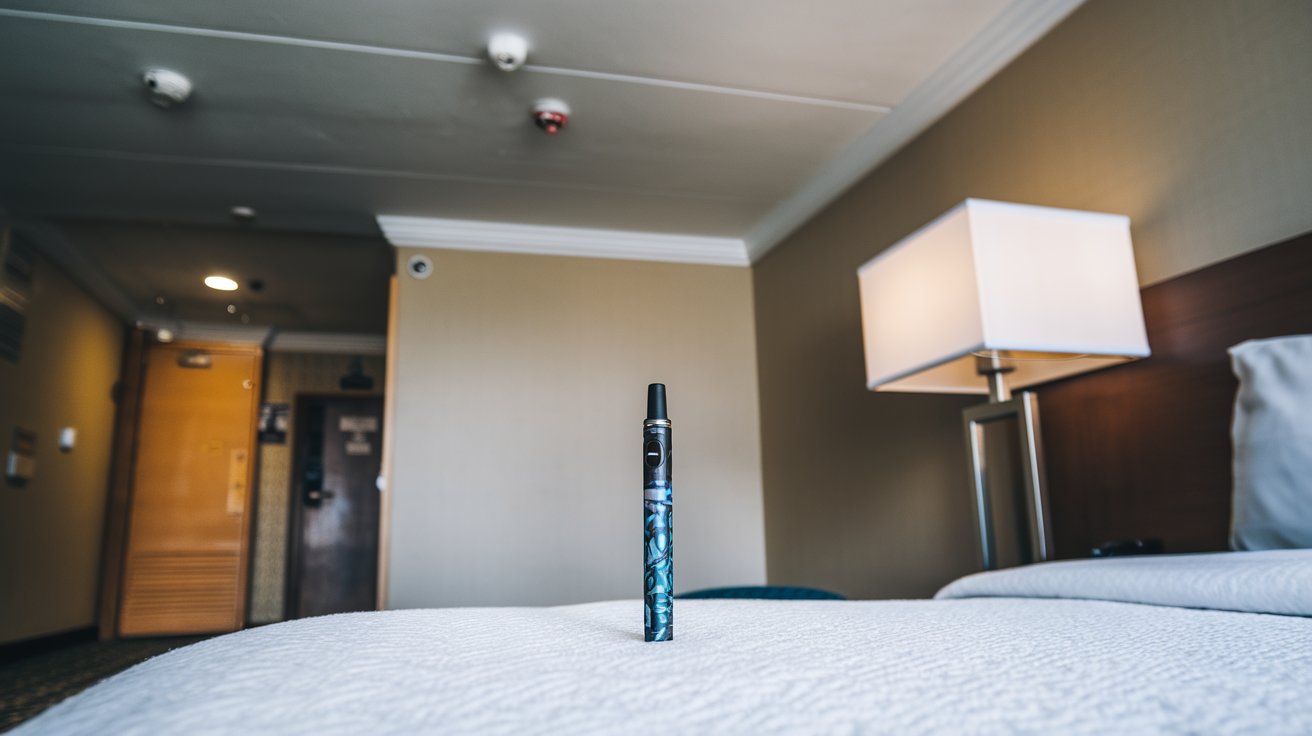
Guests curious about what vape detectors look like often fail to identify them, as manufacturers design devices to blend with standard room fixtures. Entry-level particulate sensors resemble conventional smoke detectors: white circular units mounted on ceilings approximately 6-8 inches in diameter with indicator lights that most guests ignore. Advanced chemical sensors like the FreshAir Sensor 2.0 appear as rectangular white panels measuring roughly 5×3 inches, mounted on walls near HVAC returns or beside standard smoke detectors, often mistaken for occupancy sensors or environmental controls.
Some integrated hotel room systems incorporate air quality monitoring into thermostat assemblies or multi-function control panels, making them completely invisible as distinct detection devices. The Wynd Sentry, popular in mid-tier properties, features a subtle wood-grain or white plastic housing that resembles a small wall clock or air freshener unit, with a single LED indicator that illuminates only during detection events. Luxury hotels sometimes install sensors within decorative vent covers or behind perforated acoustic panels as part of architectural integration strategies that maintain aesthetic standards. The key identifier guests should recognize is the small perforated intake screen present on all air quality sensors, necessary for continuous air sampling. However, since these features mirror those on legitimate environmental controls like carbon monoxide detectors and humidity sensors, visual identification proves challenging without specific knowledge of installed systems. Hotels intentionally maintain this ambiguity, as overt surveillance aesthetics create discomfort that conflicts with hospitality standards.
Specific Hotel Chain Policies
Major hotel brands maintain distinct vaping policy implementations despite industry-wide prohibition trends. Marriott International, encompassing brands from Fairfield Inn to Ritz-Carlton, enforced comprehensive vaping prohibitions across its North American portfolio starting January 2023, with detection technology deployment reaching 78% of properties by 2026. The chain’s policy imposes standard $250 cleaning fees at mid-tier brands and $400-$500 at luxury properties, with consistent enforcement tracked through centralized compliance reporting that franchise owners must maintain to preserve brand affiliation.
Hilton Hotels Vaping Policies and Detection
Hilton Worldwide, managing brands from Hampton Inn to Waldorf Astoria, implemented portfolio-wide vaping prohibition in 2022, with accelerated sensor deployment throughout 2024-2025. Guests asking can you vape in a Hilton hotel room receive clear policy communication during booking confirmation and check-in, with signage in all guest rooms explicitly prohibiting vaping alongside traditional smoking. Hilton’s detection strategy emphasizes its CleanStay program, which includes air quality monitoring as a core component of room hygiene protocols. The chain reports that sensor deployment reduced vaping incidents by 64% between 2023 and 2025, while cleaning fee revenue decreased by 41%, indicating successful deterrence rather than profit-seeking through violations. Hilton maintains a tiered enforcement approach: first-time offenders receive educational communication alongside the standard $300 cleaning fee, while repeat violations trigger Hilton Honors account restrictions and potential permanent booking privileges suspension.
IHG and Holiday Inn Vaping Policies
InterContinental Hotels Group, operating Holiday Inn, Holiday Inn Express, and Candlewood Suites among others, maintains brand-specific policies with common elements. Holiday Inn properties prohibit vaping in standard guest rooms while offering smoking-permitted options at approximately 40% of locations, higher availability than most competitors. The chain’s franchise model creates some policy variation, with individual owners implementing detection technology at different rates, though corporate standards require minimum compliance. Holiday Inn Express properties, targeting business travelers, demonstrate the highest detection technology adoption at 81% as of 2026, reflecting guest demographics with lower smoking and vaping rates. IHG’s cleaning fee structure ranges from $150-$350 depending on brand tier, with incident documentation requirements ensuring franchise consistency. The company’s IHG One Rewards program notes violations without immediate status impacts, but multiple offenses trigger account review and potential benefits suspension.
Cost-Benefit Analysis for Guests
Rational evaluation reveals that attempting to vape secretly in hotel rooms presents poor risk-reward economics. The potential financial penalty of $150-$500 significantly exceeds any convenience gain from avoiding a brief walk to outdoor designated areas. Consider that typical vaping sessions last 5-10 minutes, and outdoor areas are located at most 60-90 seconds from most rooms, creating minimal actual inconvenience. The walking distance and time investment to vape outdoors amount to approximately 3-5 minutes of additional time per session, while detection risk exposes guests to financial penalties representing 20-40% of typical multi-night stay costs.
Beyond immediate cleaning fees, consequences include potential reservation termination without refund, lost loyalty program points and status, and restrictions on future bookings at the same brand. A guest paying $150 per night for three nights risks losing $450 in accommodation costs plus the $300 average cleaning fee, totaling $750, to save perhaps 30 minutes of cumulative walking time to outdoor vaping areas across the stay. For frequent travelers, brand restrictions prove even more costly, potentially eliminating preferred hotel options in dozens of cities and preventing accumulation of benefits worth hundreds or thousands annually. The calculus becomes clearer when considering that smoking-permitted rooms remain available at many properties for $25-$75 nightly premiums, meaning guests can legitimately vape indoors for substantially less than potential violation penalties. The rational choice prioritizes compliance through outdoor area use or booking appropriate room categories.
Related video about can you vape in a hotel room
This video complements the article information with a practical visual demonstration.
Key Questions and Answers
Can hotels tell if you vape in a room?
Yes, hotels can definitively tell if you vape in a room through multiple detection methods. Modern properties use environmental sensors that identify specific chemical signatures in vapor, including glycerin, propylene glycol, and flavoring compounds. These sensors achieve 96-98% accuracy in distinguishing vaping from other activities. Additionally, housekeeping staff are trained to recognize physical evidence including glycerin film on mirrors and glass, residue on fabrics, and characteristic sweet odors. Properties document violations with timestamp data, chemical analysis, and photographs, providing irrefutable evidence that makes denial ineffective.
Will vaping make a hotel smoke alarm go off?
Vaping can trigger hotel smoke alarms, though it depends on device type and alarm technology. Traditional ionization alarms rarely activate from normal vaping, but dense vapor clouds from high-output sub-ohm devices can trigger photoelectric sensors. Industry data shows approximately 12% of smoke alarm activations in non-smoking rooms result from vaping. Modern multi-sensor fire systems recognize vaping signatures and generate silent alerts to security rather than building-wide alarms. If an alarm does activate, guests face cleaning fees plus additional charges of $100-$300 for emergency response costs, and potentially municipal fines of $250-$500 for false alarms in some jurisdictions.
Can I hit my pen in a hotel room?
No, you should not use vape pens in hotel rooms, even though small pen-style devices produce minimal vapor. While detection probability is lower with discreet pen devices compared to larger mods, it is far from zero, particularly in properties with advanced chemical sensors that detect compounds at concentrations as low as 5 parts per billion. Major hotel chains including Marriott, Hilton, and IHG explicitly prohibit all vaping devices in guest rooms. Violation results in cleaning fees of $150-$500, potential immediate reservation termination, and restrictions on future bookings. The minimal inconvenience of using designated outdoor areas makes compliance the rational choice.
How do hotels know if you vape in your room?
Hotels detect vaping through advanced environmental sensors, trained housekeeping inspection, and physical evidence analysis. Smart sensors continuously monitor air quality, identifying volatile organic compounds specific to e-cigarette vapor including glycerin particles, propylene glycol, and nicotine derivatives. When vaping occurs, systems alert management with timestamp and chemical composition data. Housekeeping staff recognize glycerin film on glass surfaces, residue on electronics, and distinct odors in fabrics that differ from cigarette smoke. Some properties use black-light inspections revealing vapor residue patterns invisible to the naked eye. This multi-layered detection approach makes undetected vaping extremely difficult in modern hotels.
What does a vape detector look like in a hotel?
Hotel vape detectors typically resemble standard environmental controls, making them difficult to identify. Entry-level particulate sensors appear as circular white ceiling-mounted units similar to smoke detectors, 6-8 inches in diameter. Advanced chemical sensors like the FreshAir Sensor mount on walls as rectangular white panels approximately 5×3 inches, often beside smoke detectors or near HVAC returns. Some integrated systems incorporate detection into thermostat assemblies or multi-function control panels, making them invisible as distinct devices. The identifying feature is a small perforated intake screen for air sampling, though this mirrors legitimate environmental sensors, maintaining intentional ambiguity that balances detection capability with hospitality aesthetics.
Are there hotels that allow vaping in rooms?
Yes, approximately 35% of full-service U.S. hotels maintain smoking-permitted rooms where vaping is allowed, typically representing 5-15% of total room inventory. These rooms undergo enhanced ventilation and deep cleaning protocols, commanding premium rates of $25-$75 per night above standard rooms. Casino hotels in Nevada, select extended-stay chains, and some independent boutique properties offer the highest availability. Guests should specifically request smoking-permitted rooms during booking, as most properties default to non-smoking inventory. Third-party booking platforms now include filtering options to identify properties with smoking-permitted rooms. Some hotels offer private patios or ground-floor rooms with outdoor access where vaping is permitted in personal exterior spaces.
| Key Consideration | Important Details | Guest Action |
|---|---|---|
| Detection Technology | 92% of major hotels use environmental sensors with 96-98% accuracy detecting vapor chemicals | Assume vaping will be detected regardless of precautions taken |
| Financial Penalties | Cleaning fees range $150-$500 depending on property tier, plus potential reservation termination | Budget for smoking-permitted room premiums ($25-$75/night) instead |
| Policy Enforcement | Marriott, Hilton, IHG, Hyatt maintain comprehensive no-vaping policies with consistent enforcement | Use designated outdoor areas located 60-90 seconds from rooms |
| Loyalty Impact | Violations trigger account restrictions, status review, and potential permanent booking prohibition | Protect valuable loyalty benefits through policy compliance |
| Legal Framework | 23 states prohibit indoor vaping; local ordinances often exceed state requirements | Research specific property policies during booking process |
| Alternative Options | 35% of full-service hotels offer smoking-permitted rooms; outdoor areas universally available | Request appropriate room category or plan for outdoor area usage |